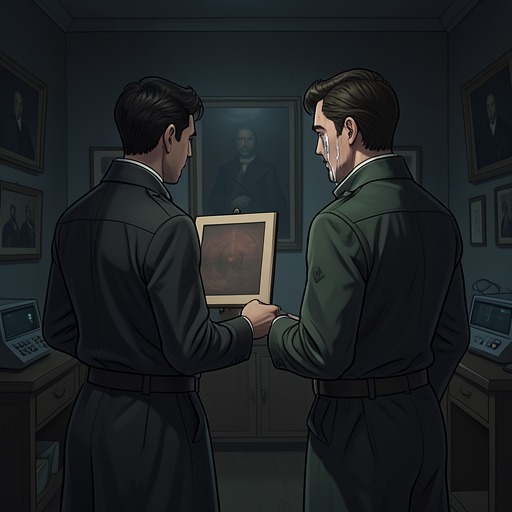
The Supreme Secret of the Order
Across the River and into the TreesThe Supreme Secret of the Order is the aphorism Richard Cantwell reveals to a new member of The Order: “Love is love and fun is fun. But it is always so quiet when the gold fish die.” Presented as the Order’s one essential secret, it is less a rule than a compact, melancholy account of attachment and loss. Its plainness makes the solemnity around the revelation gently comic, while its final image anticipates the conversation about love and permanent emptiness that follows.
The Secret and Its Revelation
The secret is disclosed after the girl objects that she cannot drink to a man she calls a swine and says she does not belong to The Order. The Gran Maestro answers that she is now a member “Por merito di guerra,” though she has not yet received her parchment, and appoints her Super Honorary Secretary. He tells her that Richard Cantwell will reveal the Order’s secrets, then prompts him to proceed. The promotion and initiation are presented with ceremonial formality, but the honorary title and staged language also give the ritual a playful, improvised quality.
Richard Cantwell first checks whether anyone else is present. Once the Gran Maestro invites him to continue, he identifies a single major secret and warns the girl to listen carefully. The revelation is not a doctrine, password, or practical instruction: it is the saying about love, fun, and the quiet death of goldfish. The Gran Maestro immediately confirms that the secret “has been revealed,” completing the ceremony as if the aphorism were an official piece of knowledge passed from one member to another.
Ceremony, Membership, and Tone
The scene makes membership tangible through recognition and appointment, even before the new member receives her parchment. The girl accepts the invitation to drink to the person at issue and asks whether she is truly a member; the Gran Maestro confirms that she is. Her pride and happiness coexist with her judgment that the Order is “a rather rough Order,” a description Richard Cantwell endorses. That exchange places the secret within a fellowship whose ritual is affectionate but deliberately unsentimental.
The revelation’s solemn framing contrasts with its everyday image. Richard Cantwell calls it the supreme secret and asks the girl to listen carefully, yet what he offers is a short observation about goldfish dying. The gap between grand announcement and modest saying is part of the joke, but it does not cancel the sadness: the line’s final quietness gives the Order’s rough humor a serious undertone.
Love, Loss, and the Secret’s Echo
After the Gran Maestro leaves, Richard Cantwell looks toward the Grand Canal of Venice and tells the girl that he loves her. She answers that he has not said so for quite a while, but that she loves him. He then asks what happens to people who love each other. Her answer—that they are more fortunate than others, until one of them gets “the emptiness for ever”—extends the secret’s image of quiet death into the human experience of bereavement and separation.
Richard Cantwell asks her not to have any emptiness, and she says she will try, adding that she has been trying since she woke up and since they knew each other. The aphorism therefore does not remain a self-contained joke or password. In the adjoining conversation, it becomes a lens for understanding the vulnerability inside their love: happiness and attachment are real, but so is the silence and emptiness that loss can leave. The Order’s supreme secret is memorable precisely because it holds both truths without turning either into a grand explanation.